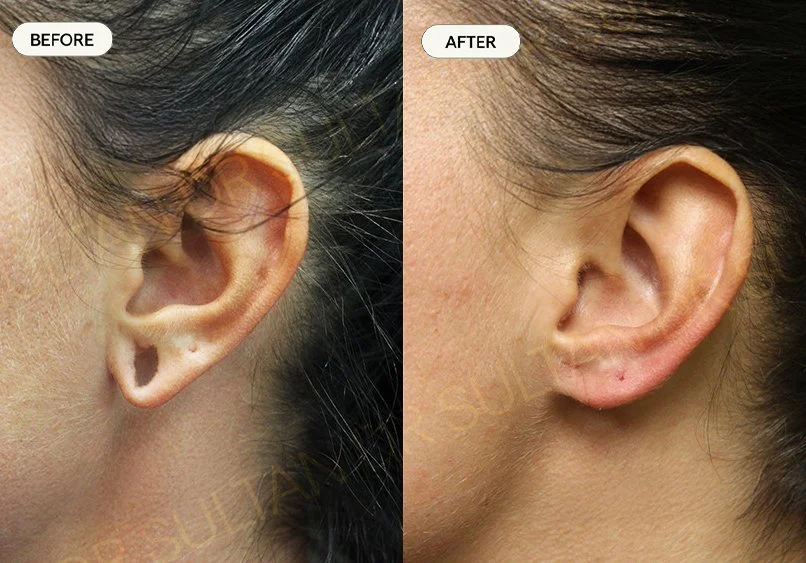
Torn or Stretched Ear Lobes: Causes, Correction Options and Recovery in London
A torn or stretched earlobe is a surprisingly common concern, one that patients often manage or conceal for years before seeking treatment. Whether the result of a sudden tear, years of heavy earring wear, or deliberate gauge stretching that is no longer desired, damaged ear lobes do not resolve on their own.
This blog covers the most common causes of earlobe damage, the correction options available in London, and what recovery involves, drawing on the procedures Dr Sultan performs at his Chelsea clinic.
Common Causes of Torn or Stretched Ear Lobes
Traumatic Tears
A traumatic earlobe tear occurs when an earring is caught and pulled through the lobe by clothing, jewellery, a child's hand, or a similar force. This typically results in a split that runs from the piercing hole to the lower edge of the lobe. The severity ranges from a partial tear (where tissue remains connecting the two sides) to a complete split.
Without repair, a traumatic tear does not heal cleanly. The skin edges retract, and scar, and earrings cannot be worn again in that location.
Chronic Stretching From Heavy Earrings
Years of wearing heavy or large earrings gradually elongate the piercing hole. What begins as a neat, round piercing slowly becomes an oval, then a keyhole shape, then a slit running partway through the lobe. Many patients reach their 40s or 50s and find that standard earrings no longer sit correctly, or that the hole has migrated significantly from its original position.
Gauge Stretching
Gauge stretching, the deliberate widening of a piercing hole using progressively larger jewellery, produces a lobe appearance that some patients later wish to reverse. The degree of correction achievable depends on the size of the gauge and the amount of remaining tissue, which is assessed individually at consultation.
Age-Related Changes
As the ear lobe loses volume and elasticity with age, the skin becomes thinner and less supportive of jewellery. Piercings that were once well-positioned may begin to migrate, holes may widen, and the lobe itself may sag. These changes can be addressed through earlobe repair and, in some cases, through volume restoration with filler.
Correction Options for Torn and Stretched Ear Lobes
Surgical Repair
Surgical repair is the most effective and permanent correction for torn and stretched ear lobes. Performed under local anaesthetic at Dr Sultan's Chelsea clinic, the procedure involves removing the damaged or scar tissue and carefully suturing the lobe back to a natural shape.
The technique varies depending on the type of damage:
• For split lobes: the edges of the tear are freshened and sutured closed in a fine, precise repair
• For elongated holes: the stretched tissue is excised and the lobe reconstructed to restore the correct shape
• For gauge reversal: the stretched lobe tissue is removed, and the remaining tissue is used to reconstruct a natural-looking lobe
The procedure takes 20 to 40 minutes per ear, and patients are comfortable throughout. Both ears can be treated in the same session.
Volume Restoration
For patients whose primary concern is age-related thinning and deflation of the earlobe rather than a tear or stretch, dermal filler can restore volume and improve the structural support for earrings without surgery. This is a less invasive option for a specific subset of patients and is discussed at consultation.
Recovery After Ear Lobe Repair
Recovery following earlobe repair is typically straightforward. Most patients find the recovery easier than they anticipated.
• Days 1–3: Some tenderness and mild swelling around the repair site settle quickly
• Days 4–7: The area continues to heal; the lobe should be kept dry and clean
• Days 7–10: Follow-up appointment to review healing and assess sutures
• Weeks 2–6: Progressive healing; scar tissue matures and becomes less visible
• Weeks 6–8+: Piercing can typically be considered once the tissue is fully healed
Dr Sultan recommends piercing through a fresh area of tissue rather than through the repair site itself, and advises on appropriate earring weight and style to prevent recurrence.