Answering Questions About the Earlobe Repair Treatment
Ear lobe repair is one of the most straightforward procedures performed at Dr Sultan's Chelsea clinic, yet it generates some of the most detailed questions from patients beforehand. If something is going to be done near your ear, it makes sense to understand it thoroughly.
Below are the questions Dr Sultan hears most consistently, with clear and direct answers. For anything not covered here, a consultation at 8 Hollywood Road, Chelsea, is the best next step.
Questions About Suitability
Who is earlobe repair suitable for?
Ear lobe repair is suitable for adults with split, torn, stretched, or damaged ear lobes who want a permanent correction. There is no strict age limit. Patients in their 20s through to their 70s present for this procedure, often for different reasons. Younger patients frequently experience gauge reversal or piercing damage, older patients for age-related elongation or accumulated stretching from years of earring wear.
Do I need a referral to book a consultation?
No referral is needed. Patients can contact Dr Sultan's clinic directly to arrange a consultation. The consultation will include a full assessment of the ear lobe, a discussion of the appropriate repair technique, and an opportunity to ask questions before any treatment is agreed upon.
Is earlobe repair suitable if I have a history of keloid scarring?
Patients with a history of keloid scarring require careful assessment before earlobe repair, as surgical procedures to the ear can sometimes trigger further keloid formation in predisposed individuals. Dr Sultan will review the patient's scar history at consultation and advise on whether repair is appropriate, and if so, which technique minimises the risk of recurrence.
Questions About the Procedure
How is earlobe repair performed?
The procedure is a minor surgical correction carried out under local anaesthetic. The damaged tissue, whether a split, stretched hole, or gauge, is excised, the edges are freshened, and the lobe is sutured closed with fine stitches. The technique varies slightly depending on the type and severity of damage, but in all cases, the aim is a clean, natural-looking result.
How long does the procedure take?
A straightforward split repair typically takes 20 to 30 minutes per ear. More complex cases, such as gauge reversal or repair of a significantly elongated lobe, may take longer. Both ears can be treated in the same session.
Will I be awake during the procedure?
Yes. Ear lobe repair is performed under local anaesthetic, which means patients are awake and comfortable throughout. The anaesthetic takes effect quickly and makes the procedure painless. There is no requirement for sedation or general anaesthesia.
Does it hurt?
During the procedure, the local anaesthetic eliminates discomfort. Patients may feel pressure or movement but not pain. In the hours after the anaesthetic wears off, some tenderness is expected. This is manageable with standard over-the-counter pain relief and settles within a few days.
Questions About Recovery
What does recovery involve?
Recovery is typically straightforward. In the first week, the priority is keeping the area clean and dry. Patients should avoid touching the ear unnecessarily, keep it out of water (no swimming or submerging in baths), and refrain from wearing earrings in the treated ear. Swelling and tenderness are normal and settle within one to two weeks.
When are the stitches removed?
Dr Sultan uses fine sutures that are reviewed at a follow-up appointment, typically 7 to 10 days after the procedure. Depending on the type of sutures used, they may be removed at this appointment or allowed to dissolve naturally.
How long until I can wear earrings again?
Most patients are advised to wait a minimum of six to eight weeks before repiercing. The exact timing depends on how well healing has progressed, which is assessed at follow-up. Dr Sultan will advise on the ideal piercing location, typically slightly away from the original hole or repair site.
Will there be a visible scar?
All surgical procedures leave some degree of scarring. With ear lobe repair, the aim is a fine, linear scar that settles over time and becomes very discreet. In most patients, the scar is not noticeable once earrings are worn again.
Questions About Gauge Reversal
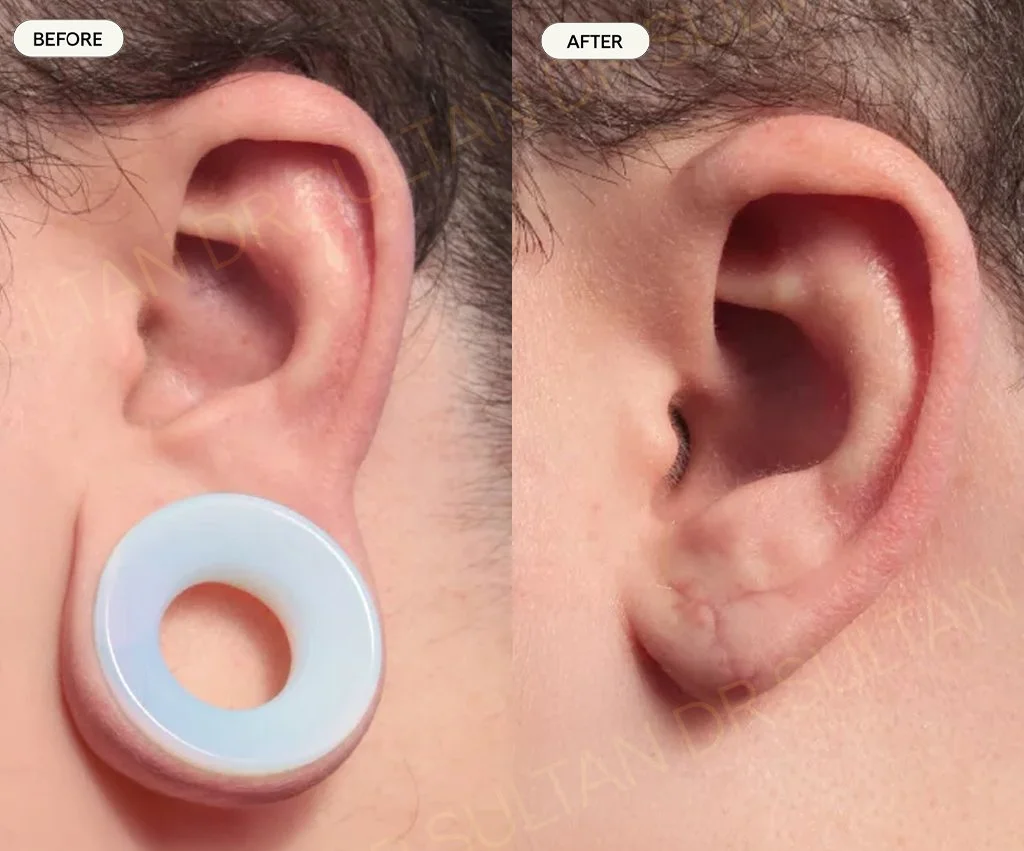
Can gauged ears be repaired?
Yes. Gauge reversal, reconstructing an ear lobe that has been deliberately stretched, is a more involved procedure than a standard split repair, but it produces reliable results. The stretched tissue is removed, and the lobe is reconstructed to a natural shape. The result depends on the size of the gauge and the amount of remaining tissue, which is assessed at consultation.
Will a reversed gauge look completely normal?
The goal is a natural-looking result, and in most cases, this is achievable. There will be a small scar at the repair site, which typically becomes very discreet as it matures. For patients with very large gauges, the available tissue may limit how closely the result can replicate an unmodified ear lobe. This is discussed honestly at the consultation.
Final Thoughts
For a thorough assessment of ear lobe damage and a clear recommendation on the most appropriate repair approach, contact Dr Sultan's clinic at 8 Hollywood Road, Chelsea, SW10 9HY.